The Story behind the Painting
Finding Inspiration
Fields of Summer is not just another farm painting. It is rooted in something much more meaningful.
I created this piece for the South Carolina State Fair Competition with the goal of creating a painting for their newest award, Roots in Agriculture. The reason I wanted to create a piece specifically for this award ties to my own experiences as an artist here in South Carolina.
Most of you who have been following along on my journey know that I sell my artwork at local events, whether they are artisan markets, maker events, or local art shows. But one of my favorite events during the year is the Ag + Art Tours that each South Carolina county holds. I have participated in three different counties Ag and art tours, Lexington, Richland and Calhoun. These events have given me the opportunity to visit farms and properties all across the state, and meet the hard working farmers who work them everyday.
Over the past few years, I have found myself becoming increasingly interested in Farming and Agriculture and it started with the book from Eric Sloane titled I Remember America. Sloane's book is a collection of observations about America’s past that, in many ways, was beginning to disappear. He wrote about the tools, buildings, trades, and everyday ways of life that had once been a familiar part of the American landscape. One of the things that really stuck with me from the book was the idea of agrarianism and the important role that agriculture played in America's early identity. The more I learned about it, the more I began to appreciate how deeply connected American history is to the land. Agriculture was not simply a way of producing food; for many of the country's early thinkers, it represented independence, self-sufficiency, and hard work. The image of the farmer working his own land, became an important part of the American ideal.
I think what attracted me to this idea was connection to the land that I feel when I am painting outside; how different it feels from much of modern life. We buy food at a grocery store without necessarily thinking about the field it came from, the person who grew it, or the amount of work that went into producing it. The book made me start paying more attention to the farms I passed, the old barns scattered throughout the countryside, the patterns of crops in the fields, and through my experience with Ag+Art I got to meet the people who work to keep these farms alive. There is something so special about being able to stand in a field and paint the exact place where the food we eat is grown. It has also made me appreciate how much of the character of South Carolina is tied to agriculture.
So when I saw that the State Fair had introduced an award specifically celebrating agriculture, I knew I wanted to make a painting for it!
Who Made this Painting Possible?
One of my first events here in South Carolina was the Calhoun County Ag + Art Tour, and coincidentally, it was also the county's first time participating in the event. I feel that small coincidence has helped foster a great relationship, not only with the lovely organizers of the event but with the community itself. For the 2026 Ag + Art Tour, I decided to do something a little special. I created five paintings, one for each of the farms and properties that participated in Calhoun County's Ag + Art Tour. (You can see those paintings here.)
One of the best parts of creating those paintings wasn't necessarily the painting itself, it was getting to meet the farmers and property owners and talk to them about their farms. Every place had its own story. I learned about what they grew, how they worked the land, and what made each property unique. Those conversations gave me a much greater appreciation for the people behind the landscapes I was painting.
So when it came time to make this painting, I knew exactly who I wanted to contact to help me find the perfect location.
I contacted the owner of Edisto Blueberry Farm, and I was not let down one bit. She gave me an amazing tour of the surrounding farms and taught me about all of the different crops they grow in the area. We drove all around her property and the surrounding farms, stopping at different locations and looking through all the possibilities. What I really appreciated was that she wasn't just showing me places that were visually appealing. She explained the history and the stories behind what made those places special. She pointed out the different crops, explained how they grow and how the fields were being used, and gave me a glimpse into the work that goes into maintaining these farms throughout the year.
As a painter, that completely changes the way you look at a landscape. A field stops being just a field. You start to see the rows, the crops, the work that went into planting them, and the people who depend on that land. Eventually, we came across the view that would become Fields of Summer.
It wasn't necessarily the most dramatic landscape we had seen that day, but something about it immediately caught my attention. The rolling fields, the rows of crops, and the enormous summer sky all came together in a way that felt quintessentially Southern to me.
After finishing the tour, I spent the rest of the day painting some small studies of the landscape. From the moment I arrived, I knew I wanted to try to capture the vastness of the landscape. The problem was that I quickly realized there was no way I could capture that feeling in a single small study. Instead, I decided to break the landscape down into several key sections. Each study would focus on a different part of the scene, but when placed together, they would begin to form a larger picture of the landscape as a whole. This ended up becoming an important part of how I approached Fields of Summer. Rather than trying to fit the entire landscape into one view, I wanted to explore it piece by piece, to understand the individual fields, the crops, the sky, and the way everything connected across the property.


From Studies to the Final Painting
Once I had finished my studies, I had a much better understanding of the landscape. However, I still had to figure out how to take everything I had learned and turn it into one cohesive painting. This ended up taking much longer than I expected, and I really struggled with the composition. I wanted the road, which appeared to almost connect across the individual studies, to become an important part of the final painting. My hope was that it would lead the viewer's eye through the fields and eventually toward the barn in the distance. But when I put everything together in the larger study, I felt that the road was too direct. Instead of giving the viewer time to meander through the landscape and explore the different fields, it seemed to take them straight to the barn. I wanted the viewer to feel the vastness of the landscape; to wander through it a little before arriving at the final destination.
At this point, I had already been working on the painting for a couple of days. I was really enjoying the direction it was heading in, and there were parts of the painting that I was very excited about. At the same time, I couldn't shake the feeling that something wasn't quite right. I could have kept pushing paint around and hope that the answer would eventually reveal itself, but instead I decided to step back and return to the place where the painting had started.
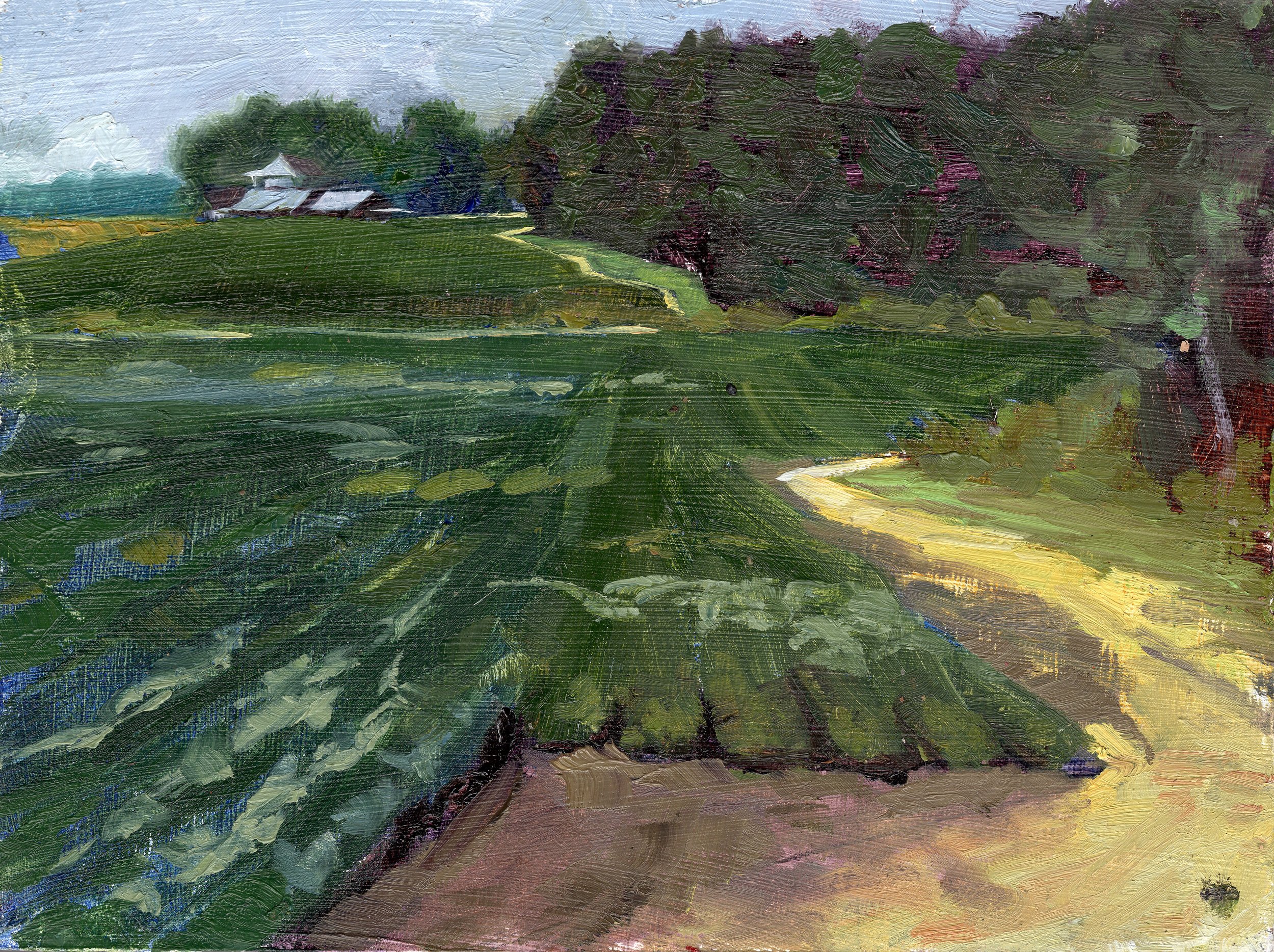
I am very happy I made this decision, because the second my feet touched that soil, everything became much clearer.
There is something about standing in front of the actual landscape that photographs and studies simply can't replace. I could see the way the road moved through the fields, how the different sections of the landscape connected, and, more importantly, how I wanted the viewer's eye to travel. This was the final painted study I completed, and after finishing it, I realized that I wanted to break the final large piece into three equal sections, each based on one of the painted studies.
The idea was that each section would be able to stand on its own and tell a small part of the story, while together they would create a much larger sense of the landscape.
In the end, that was what I wanted Fields of Summer to feel like: not a painting that tells you where to look, but a landscape that invites you to explore it.
Fields of Summer Oil on Canvas Size: 16” x 48”

Thank you to the South Carolina State Fair for creating the Roots in Agriculture award and for recognizing the important role agriculture continues to play in our state. I am grateful for the opportunity to create a piece that celebrates not only the beauty of South Carolina’s farmland, but also the people, labor, and history behind it.
A special thank you to the Calhoun County Ag + Art Tour community, the organizers who make these events possible, and the farmers and property owners who so generously welcome artists onto their land. Your stories, knowledge, and willingness to share your work have changed the way I see the landscapes I paint.
And thank you especially to the owner of Edisto Blueberry Farm for taking the time to show me around the property and surrounding farms, explain the crops and history of the area, and help me find the view that became Fields of Summer. Special thank you to the Stowe’s for letting me paint on your farm! This painting would not exist without that generosity.
I hope Fields of Summer encourages viewers to pause, and appreciate the land, the hard work, and people behind the landscapes that are such an important part of South Carolina.
Thank you so much for reading
~ Jules